Pages

Showing posts with label Hip Hop. Show all posts

Tuesday, April 20, 2010

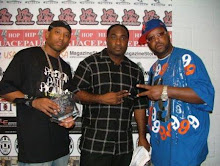
Exclusive Interview With Wisconsin Rap Group Cubed


Give us some background info as to who you are.


We are a Rap group out of Wisconsin professionally known as Cubed, We were part of a large group called Krunk Boy Entertainment and we promoted concerts and club events. We then branched off into rap music scene and we released an album called “Who Want it” in 2000. Years later three of us T.O.N.E , S.B and J.Benjaman formed The Biz and did a few tracks on a couple of D.J Flatline mixtapes. We also had a song “Midwest Riders “ on a D.j Dime Midwest compilation mixtape. We changed our name from The Biz to Cubed because there are other groups out with the name.


What is the significance of your name?


We chose Cubed because its analogous to a cubing a number in math and it significantly increases. We are a trio group with three different elements and chose Cubed because we feel that we can reach many people out there with our brand of music.


What sets you apart from other aspiring rappers?


The main thing that sets us apart is our originality and our developement. We've been developing ourselves for a long period of times and we have a lot experience recording and performing. We record as often as we can, even when we didn’t have a sense of direction we were just trying to get better and perfect our craft. We have a large catalog of music that we are ready for the world to hear.


What is the philosophy by which you live by?


Our philosophy is "What ever it is that you do, strive to be the best at it."


Which artists have inspired you?


We've been inspired by artists such as: Kanye West, Jay-Z, Diddy, 50 Cent, Wayne, Lupe Fiasco, Out Kast, Neptunes, Snoop Dogg, Chester French, Justin Timberlake and Linkin Park.


Who does your production?


Our production is mainly done by T.O.N.E, but S.B. and Rell Beats also currently do some of our production.


What is your opinion of the current state of Hip Hop?


The current state of hip hop is saturated with a lot of the same elements and not too many new artists stand out. We also understand that its all about producing hit records so it explains that the music industry look at artists from a business standpoint more than the overall talent aspect.


If you can change one thing about the music industry what would it be and why?


One thing we would change is how the music industry doesn’t recognize as many successful hip hop and R&B artists as they do with other genres of music.


Are there any singers that you would like to collaborate with in the future?


We could see ourselves collaborating with Jennifer Hudson, Jordan Sparks, Alisha Keys , Usher, Trey Songz, Matthew Santos, Sting or Phil Collins.


What producer would you like to collaborate with in the future?


We would love to do a song with Timbaland or Dr. Dre.


What is your favorite movie and favorite book?


Our favorite movie is "300" and the favorite book is "The Bible".


What are some major misconceptions that you think people have of you?


The major misconception is that Milwaukee doesn’t have talent. But, we are here to show them differently.


What is your favorite part of your live show? How has it evolved?


We really don’t have a favorite. We spontaneously do things at any given time. We used to bring a bunch of guys on stage with us but now we only show the audience who they came to see.


What is your LP going to be like?


The LP is going to be crazy because we bring back some of the elements that Hip Hop has been missing with a more current and distinct style of music that can cross over.


What is your website?


The website is www.benjamanmusic.com


Any final words for the people.


Cubed will be one of those legendary groups to break into the music industry, So stay tuned!


Monday, February 1, 2010

PROBLEM WITH THE MUSIC INDUSTRY & STEPS TO TAKE TO IMPROVE IT


By Jesse Atkinson. CEO of Urban Threshold Enterprises Inc.

Presently The American Real Estate industry is in dire straits. The Real estate industry has been flooded with an inferior product namely sub prime loans, which has resulted into a myriad of foreclosures and declining home values.

The phenomenon with in the Real Estate industry can be paralleled with the Music industry. The music industry is also in dire straits. This is especially the case for Rap music sales. Like the real estate industry, the music industry is being flooded with sub par product. Unfortunately for the music-buying public, the level of artistic quality inherent in the overall group of artists signed to major labels appears to be in a steep decline.

The major music companies have become publicly-owned mega-corporations that have abandoned artist development for bottom line, short-term financial results. The major labels are no longer in the business of producing music; Selling CDs is the primary mission. The hit driven majors have put quantity over quality. Nowadays, you don't necessarily have to be a talented artist or musician to be successful. Hype or promotion can make an artist appear to be talented. "The artist" has become a brand that is owned and operated by the label. The corporate labels have formulated a bland, one-dimensional form of Hip-hop to control and streamline their products and services.

The end result is consumer attrition or a declining consumer base. Music consumers have come to expect 1 or maybe 2 good songs on an album. Hence, they would rather illegally download a song or buy a bootleg of the album. In the past, rap music was something you heard and experienced - it was as much a social event as a purely musical one. Many Hip Hop fans are tired of the disposability of modern rap music . They want music with some substance and a product, which is free from the shackles of blind commercialism.The majority of today's rap music lacks any social commentary.

(Moreover, If record sales continue to decline, the new paradigm will involve giving away music for free & revenue will be derived from sponsorships.)

In 2008, More than 115,000 albums were released, but only 110 sold more than 250,000 copies, a mere 1,500 topped 10,000 sales, and fewer than 6,000 cracked the 1,000 barrier -It increasingly appears that recordings will be more like advertisements for opportunities that actually do make money: live performances, merchandise, licensing to movies, commercials and video games, ring tones, etc.

What must be done to turn the music industry around:

1. Better Customer Service

In just about every other industry, the customer comes first. It is imperative that the major labels focus on customer service and give music consumers more options. In the case of urban music, there is a lot of quality Hip hop & R&B that is not being heard.The majors must let the consumers determine what is a "hit" song. This can be accomplished via contests, give aways, and marketing surveys. .

2. Institute Creative Quality Control Measures as it relates to music releases.

There is a lost art of true musicianship and feeling for the music. The heart felt lyrics which were common place in the 50's and 60's is largely absent in today's music market. Creative quality control is missing. There must be an emphasis on creating better crafted songs. The creative control must even extend to record stores and distributors. Record stores rarely listen to music placed there. They don't care what the album sounds like; they only care if it sells.

3. Hire True Music Lovers:

Currently, the record labels are saturated with number crunchers who hide behind computers. The music industry is being ran by accountants and lawyers. The record labels must go back to hiring true music lovers and creative thinkers who are willing to take calculated risks.

4. Break the Radio Monopoly

The music industry is too radio driven. In the past radio stations were staffed with actual human DJs who played music they believed in. However, over the years the "true Dj's" were replaced by personality jocks who push a button to start some Clear Channel playlist. The majors must abandon the payola system and work with grass roots organizations to bring diversity to the airwaves.

5. Embrace Technology

There is no doubt that the music industry must now embrace technology, because this is the only way that the existing industry leaders can stay competitive in the future. The rest of the world has changed and adapted - and the music industry must now step up and do the same.

6. Emphasize fair Dealing with Artists they Sign

The major record labels appear to be more interested in complete cost recoupment rather than fair dealing. And in an act of desperation, the majors have implemented 360 deals, whereby they will receive a cut of the artist's merchandise, tours, CD sales, endorsements, etc.

The record company bankrolls the recording and handles the manufacturing, distribution, press, and promotion. The artist gets a royalty percentage after all those other costs are repaid. The label, in this scenario, owns the copyright to the recording.
Since artists share the costs of making the album, because these costs are recoupable from their royalties, they should also have joint ownership of the masters at some point.

7. Change Business Structure

The Record labels should move away from the CD format. The labels should move to an 80% digital distribution format, which will eliminate manufacturing costs. And as a result, they can pass the savings on to the consumers in terms of lower prices.
Obviously, the cost of these services, along with the record company's overhead, accounts for a big part of CD prices. You, the buyer, are paying for all those trucks, those CD plants, those warehouses, and all that plastic. Theoretically, as many of these costs go away, they should no longer be charged to the consumer - or the artist.

The labels should only manufacture a limited number of special edition CD's/DVD to be sold at concerts only. These special edition CD's/DVD's will contain bonus songs and behind the scenes footage of the artists. The price of the concert should include the cost of the CD/DVD, to ensure that each concert goer receives the special edition CD/DVD